
THE FIRST FINAL SOLUTION: IMPERIAL GERMANY’S MASSACRE OF THE HERERO AND NAMA
Part 5 of a 30 part history of the Great War, 1914-18

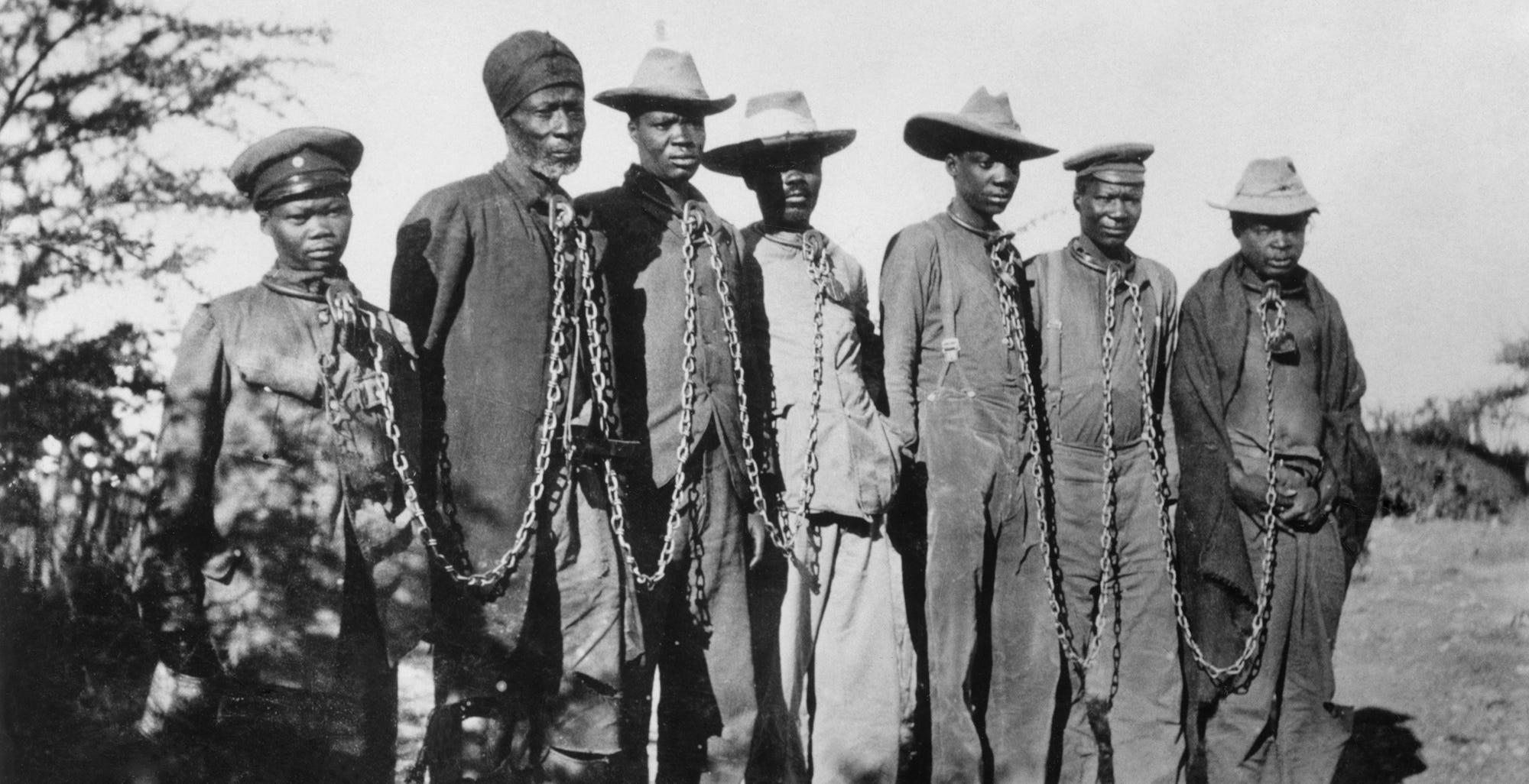
You may not have heard of the Herero and Nama peoples of South-West Africa. Which is hardly surprising; Kaiser Wilhelm II -the man who took Germany into the Great War- almost succeeded in removing them from the face of Earth in what is now recognised by the UN as the first genocide of the 20th century. https://p-crc.org/2019/04/06/not-the-holocaust-but-the-herero/
The Kaiser’s mass murder of the pastoralist Herero and Nama tribes between 1904 and 1907 was no accident, no aberration: Homicidal racism ran through the Kaiser’s court and German conservative politics. Hitler’s Final Solution was only the end of a very long, tainted thread. The origins of Wilhelm II's mass murder of the Herero and Nama lie in the raising of the German flag on the coast of South-West Africa in 1883.
Deutsch-Sudwestafrika (now Namibia) was more than a place in the sun, part of Germany’s imperialist ‘scramble form Africa’, it was a testing ground for Lebensraum, or living space. The Lebensraum policy of expansion was advocated by the 19th-century German geographer Friedrich Ratzel, who distorted Darwin's theory of evolution to proclaim that migration was necessary for a race's survival.
On African soil a "New Germany" was to be created. The seizure of land from the Herero and Nama peoples was c alibied by their ‘inferior’ racial status. The Herero and Nama, however, were far from being the ‘savages’ of Wilhelmine racial classification; indeed many Nama were the mixed-race, Christian offspring of earlier Dutch settlers.
In January 1904, after two decades of their cattle and land being stolen by German immigrants the Herero, under their chief Samuel Maharero, revolted. The Berlin government accordingly dispatched Lieutenant-General Lothar von Trotha and 14,000 soldiers to the insurgent colony. General Trotha's task was more than the subduing of the Herero insurrection. He was to conduct a ‘racial struggle’ against them. Trotha announced his programme with chilling clarity: ‘I believe that the nation [the Herero] as such should be annihilated. Only following this cleansing can something new emerge, which will remain.’
After beating the Herero in the battle of Waterberg, Trotha drove the survivors into the pitiless Omaheke desert with the intention they should die from thirst and starvation. Waterholes were poisoned by "cleansing patrols" of the Schutztruppe, the colonial army, to prevent the Herero from using them.
In Berlin the German general staff publicly lauded Trotha for his ‘extermination’ measures. By 1905 Herero fugitives still alive in the Omaheke were too weak to do anything but surrender. They were rounded up, put into cattle wagons and sent by train to concentration camps, where they became slave labour for the colony's new railways.
Women were systematically raped by Schutztruppen, the incidents turned into photographs by the new-fangled Kodak roll-fill camera. The pictures were then sent as pornographic postcards to Germany.
Food was so scarce in the concentration camps that, according to a witness, when rations were distributed, ‘prisoners fought like wild animals and killed each other to secure a share’. Inmates died in nightmarish numbers; after two years the main concentration camp at windswept Shark Island near Luderitz was obliged to close; most of its inhabitants had perished. Even the German guards called Shark Island ‘The Death Camp’.
Something more sinister than extermination by starvation occurred at Shark Island however; the prisoners were used in racial ‘science experiments’. The Shark Island camp physician, Dr Bofinger, conducted medical tests that prefigured those of Josef Mengele, the Nazi ‘Angel of Death’, at Auschwitz in the Forties.
In a specious bid to determine whether scurvy, an illness caused by lack of vitamin C, was contagious, Bofinger injected prisoners with arsenic and opium.
Research on cadavers was uncontrolled. According to German medical statistics 778 autopsies were conducted in the concentration camps in one year alone. Eminent anthropologist Eugen Fischer voyaged to South West Africa to study the phrenology of the Herero and the Nama. Phrenology, of course, being a pseudoscience that assesses head shape to determine mental and psychological characteristics.
More than 3,000 skulls of Herero and Nama were sent to German universities for experimentation; in some cases, Herero women were made to boil, and clean with broken glass, the specimen heads of their own people.
In Germany the skulls were used to prove the similarity between the Herero/Nama and anthropoid apes. A sane wing of the German establishment, including the chancellor Bernhard von Bulow, tried to stop the outrages as ‘contrary to Christian and humanitarian principle’. Bulow was also aware that the genocide was damaging to Germany's international reputation. But the Kaiser and the military were largely beyond political control, constituting a state within the state. Not until 1907 did domestic and international pressure succeed in making the Kaiser call off the holocaust.
By then the Herero population had gone from 100,000 to 15,000 and half of the 10,000-strong Nama had been killed.
Although overt German imperial murder of black Africans in Namibia stopped, their persecution was unabated.
In 1912, on the basis of Eugen Fischer's recommendations, interracial marriage was prohibited throughout the German colonies. All Africans over seven years of age were required to carry a token, the so-called ‘pass mark’ around their necks, as a sign of their inferior status.
The links between the Kaiser's holocaust and Hitler's are sobering. The ubiquitous Eugen Fischer later taught medicine at the University of Berlin to Nazi physicians; his students included Josef Mengele.
Admirers of Fischer's racist Principles Of Human Heredity And Race Hygiene included Adolf Hitler. The future Fuhrer used the eugenic principles in the book to underpin his dream of a pure Aryan nation in his manifesto, Mein Kampf (My Struggle).
An enthusiastic protagonist in the extermination of the Herero was a Bavarian lieutenant called Franz Epp. He later secured the funding for the Nazis' first newspaper. In the Thirties Epp was the Nazi Reichskommissar for Bavaria, watching over the extermination of its Jews and Roma.
Almost symbolically, the first uniform of the Nazis was a job lot of surplus desert-wear Schutztruppe kit. Designed for colonial warfare in arid South West Africa, Schutztruppe shirts were sandy brown. Hence the Nazis who donned them being known as the Brown Shirts.
In the strange, cruel mind of Kaiser Wilhelm II there lurked other ‘Untermenschen’, or sub-humans. From his early 20s Wilhelm was an ardent anti-Semite. ‘They want stamping out,’ he complained of the Jews.
His appalled father, Frederick III, who deserves a posthumous Medal for Decency, attended the Berlin synagogue in full military uniform to show solidarity with the Jewish people.
‘Asiatics’ also earned the Kaiser's loathing. Like Hitler, he considered himself a dab hand with a paintbrush. He daubed a fantasy picture adding the inscription "Volker Europas, wahrt eure heiligsten Guter" (People of Europe, defend your holiest possessions), which showed white Europe marching against the Yellow Peril, represented by, of all people, Buddha.
Most infamous among the Kaiser's anti-Asiatic rants was his address to German troops about to depart for China to suppress the Boxer Rebellion. Standing at Bremerhaven docks he urged his soldiers to be ‘like the Huns under their king Attila. Prisoners will not be taken!’.
This lamentable call to genocide in the manner of the barbaric Dark Ages chieftain gave the Germans their nickname in the Great War: The Huns.
What does the holocaust of the Herero and Nama have to with the Great War? Well, it raises the disturbing questions about the nature of Wilhelmine state. Here is the thing – The German drive east in 1914 was more than a military offensive, it was search for Lebensraum and in the mind of the Kaiser’s circle a ‘race war’ against the Slavs, another group of ‘Untermenschen.’ . Or as Kaiser Wilhelm II put in 1912, ‘There is about to be a racial struggle between the Teutons and the Slavs… it is the future of the Hapsburg monarchy and the existence of our country which are at stake.’ Victory for Germany in 1914 would likely have freed the hand of the Kaiser and his circle to enact their proto-fascist fantasies. No matter who started the First World War the right side won.